

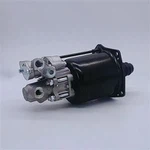
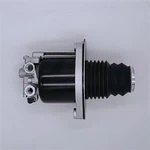
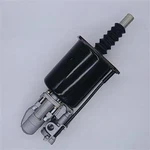
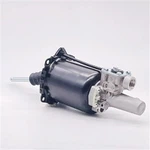
Relay Valve
Our goal is to become your true partner in the field of air dryer in China. Zhuji Bangna Auto Parts Co., Ltd is a factory specializing in clutch booster and air dryer in Zhuji. We can provide supporting services to customers. Our company is committed to applying advanced manufacturing technology and strict quality control standards to every product. The price is competitive and the product is quality-assured, which is a good choice for your long-term cooperation.


Why Choose Us
Production Equipment
Our company's equipment includes precision machining center, bench drilling machine, pneumatic test lathe, hydraulic test lathe, CNC machine tools, die casting machine, etc.
Our Certificate
Our products strictly comply with relevant standards and have passed TS16949:2009 certification.
Production Market
Our products are very popular in the market, and the main sales areas of our products involve domestic and foreign markets, such as Russia, Dubai in the Middle East, Saudi Arabia, Iran, Turkey, India, Africa, etc.
Our Service
The company has a professional sales team to provide you with high-quality pre-sales consulting services. During the order production process, customers can communicate with us at any time to understand the production progress. At the same time, we provide high-quality after-sales service to meet the different needs of customers.
Advantages of Relay Valve

Shorten brake reaction time
The relay valve can quickly deliver compressed air in the air reservoir to the brake air chamber, thereby significantly shortening the brake reaction time and enhancing the braking effect.

Enhanced braking effect
The relay valve quickly transmits compressed air to enable the brake shoe or brake disc to quickly generate braking force, effectively reducing the vehicle speed.

Preventing overload of mechanical transmission components
The relay valve can prevent the driving and parking systems from operating at the same time, avoiding the overlap of forces in the combined spring brake cylinder and the spring brake chamber, thereby preventing the mechanical transmission components from overloading and causing the spring brake to fail. Rapid filling and exhaust of the cylinder.

Improve the sensitivity and reliability of the braking system
Compared with traditional braking methods, the relay valve reduces the braking response time and improves the sensitivity and reliability of braking.
Technical Parameters of Relay Valve
|
Port Thread 1 |
M22 x 1.5 |
|
Port Thread 2 |
M22 x 1.5 |
|
Port Thread 3 |
Drain |
|
Port Thread 4 |
M22 x 1.5 |
|
Size (mm x mm x mm) |
104 x 100 x 105 |
Types of Relay Valve
Service brake relay valve
With a service brake relay valve installed, the hose that connects to the primary delivery-port output of the foot-valve becomes a control-line.
Spring brake relay valve
A spring brake relay valve works on the same principle as the service brake relay valve, although it has the opposite effect. This type of relay valve responds to a major drop in pressure at its control-port by opening its exhaust port, which causes the air from each spring brake chamber under its control to remotely exhaust, thus applying the spring brakes much-more-quickly than would otherwise be possible if the air were required to discharge via the yellow parking-control valve on the dashboard.
Such as in trailer or semi-trailer braking systems. In the braking system of the truck, the relay valve plays the role of shortening the reaction time and the pressure build-up time. Generally, a differential relay valve is used. To prevent the simultaneous operation of the driving and parking systems, the combined spring brake cylinder and the force in the spring brake chamber overlap, so as to avoid the overload of the mechanical transmission element, so that the spring brake cylinder can be quickly charged and exhausted.
Material of Relay Valve
Typically made of cast aluminum, brass, or steel for durability and corrosion resistance. Seals: Rubber or synthetic materials like nitrile or EPDM. Springs: High-grade steel for flexibility and strength. Diaphragms: Elastomers designed to withstand high-pressure air.
Design: Engineers create detailed cad models based on the functional requirements, including pressure rating, material, and durability.
Prototyping: 3D printing or cnc machining is used to create prototypes for performance testing.
Casting/forging: The valve body is cast or forged from the chosen material.
Machining: Cnc machining ensures precise dimensions for components like ports, bores, and mounting points.
Spring Manufacturing: Springs are fabricated using coiling machines and heat-treated for strength and longevity.
Seal/diaphragm molding
Rubber seals and diaphragms are molded using injection or compression molding techniques.
Sub-assembly
Internal components (e.G., springs, diaphragms, pistons) are pre-assembled into functional units.
Final assembly
The valve housing is combined with sub-assemblies, and fasteners are torqued to specifications.
Precautions for Use Relay Valve
For relay valves, the stability of the electrical connection is crucial. Regularly check the cables, joints and connectors to ensure that there is no looseness, corrosion or wear. Performing functional tests is an important way to verify the performance of the relay valve. Regularly verify the switching status, response time and flow control capability of the relay valve through manual operation or automated test equipment. If an abnormality is found during the test, it is necessary to repair or replace it in time to ensure the reliability of the system.
Quality Testing of Our Relay Valve
Leak testing
Valves are tested under pressurized conditions to ensure airtight seals.
Functional testing
The relay valve is tested for proper operation, including response time and pressure regulation.
Durability testing
Components are subjected to cyclic loads to evaluate longevity.
Surface Treatment of Relay Valve
Coating
Anti-corrosion coatings like anodizing, powder coating, or electroplating are applied to the housing.
Marking
Product identification, including serial numbers and specifications, is laser-etched or stamped.
Packaging and Shipping of Relay Valve
|
Packing |
Plastic bags, cartons, racks, plywood cases etc. |
|
Shipping |
Shipping, air flight, international express etc. |
Other Service of Relay Valve
|
Branded packaging |
We can provide packaging and customize products according to customer needs. |
|
Delivery time |
The order will be arranged for production after receiving the deposit. The delivery time of conventional neutral packaging products is within 20-40 days. The specific time will be determined according to the product quantity and packaging requirements. |
FAQ